

Beyond the Routine with Renew Physical Therapy
Helping Gymnasts Grow Strong for Sport — and Life
Let’s talk about...
KNEE PAIN
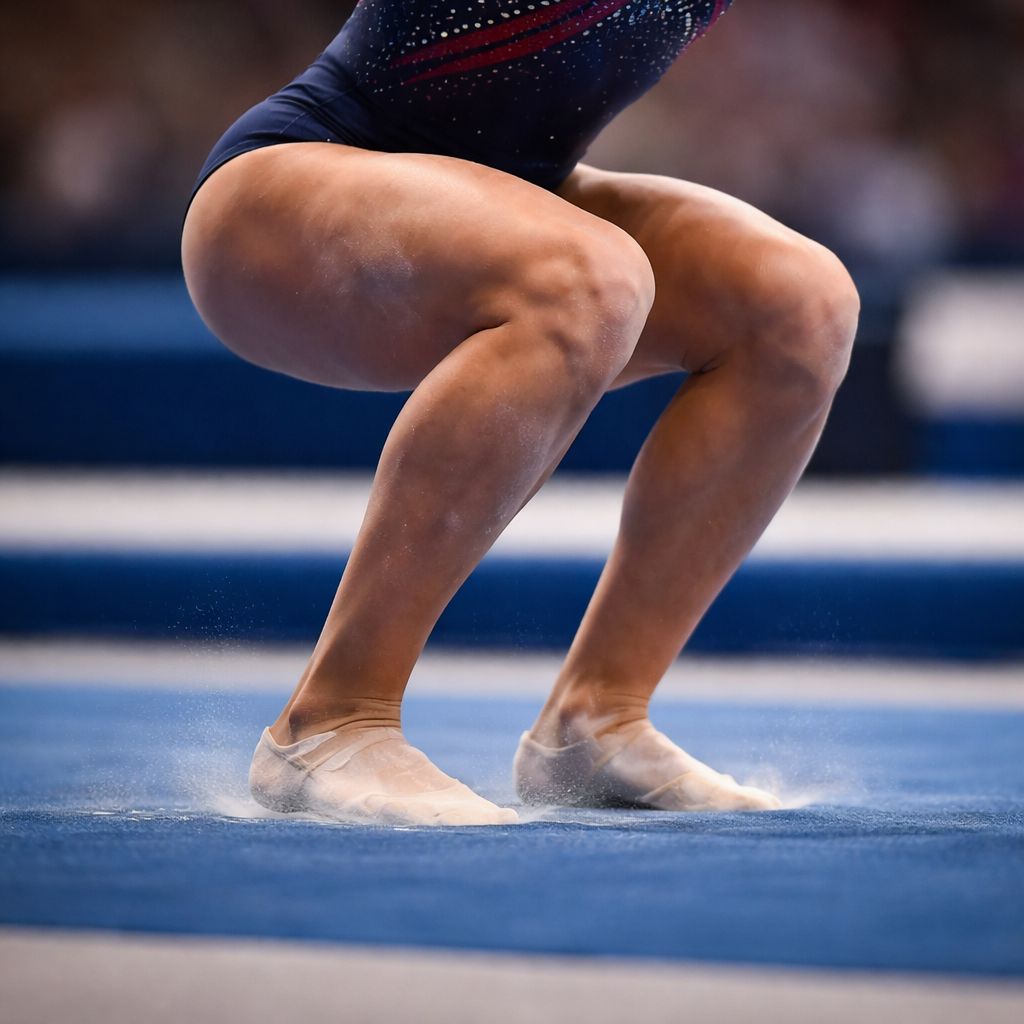
If you’re a gymnast or cheerleader, your knees work incredibly hard.
Every tumbling pass, jump, landing, or stunt puts a lot of force through the knee joint. In fact, during some landings, the knees can absorb several times your body weight in force.
That’s a lot of pounding.
Over time, if the muscles around the knee aren’t strong enough to handle those forces, the knee joint can start to get irritated or painful.
The good news: chronic knee pain in young athletes can be prevented by building strength in the muscles surrounding the knee joint.
Let’s talk about why.
The knee is a hinge joint that connects the thigh bone (femur) to the shin bone (tibia). It also includes the kneecap (patella), which helps the quadriceps muscle straighten the leg.
During tumbling, jumps, and landings, the knee has two big jobs:
- Absorb impact from the ground
- Stabilize the legs so they don’t collapse inward or twist, resulting in pain or a fall
When the muscles surrounding the knee are strong, they act like shock absorbers. They help distribute the force through the legs and hips instead of letting it all compress into the knee joint.
When those muscles are weak or fatigued, the knee takes on more of that stress directly. This can lead to pain around the kneecap, irritation of ligaments, or inflammation in the joint.
So what can you do?
The following video demonstrates some basic exercises to improve strength in the muscles surrounding the knee:
In addition to strengthening exercises, another important factor in protecting your knees is proper alignment during landings. When your hips, knees, and ankles line up correctly, they work together like a coiled spring that absorbs shock. This helps spread the force of a landing across the entire leg.
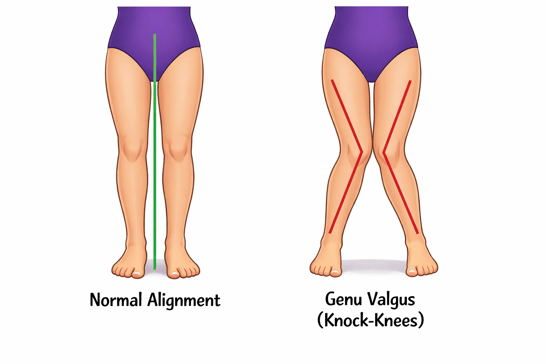
If your knees collapse inward toward each other (called “genu valgus”), it places a large amount of stress on the joints of the lower body—especially the knees. Over time, this repeated stress can lead to irritation, pain, and injury.
One simple way to practice safe landing mechanics is to use a mirror. Stand in front of a large mirror and practice jumping off a low surface, such as a folded panel mat, and “stick” your landing.
When you land, freeze in that position and check your alignment. Look at your hips, knees, and feet. Are they stacked in a straight line? Are your knees pointing in the same direction as your toes?
If everything lines up, you’re landing in a strong, safe position.
If not, adjust your stance and try again. With repetition, your body will begin to learn the correct position, and safe landing mechanics will start to feel automatic during skills and tumbling passes.
Practicing this consistently helps train your muscles to support the knee properly, reducing stress on the joint and lowering the risk of injury.
If you’re already dealing with knee pain that won’t go away, or you’re losing confidence in your landings during tumbling, or stunting, it’s worth getting it checked out by a physical therapist. Pain is your body’s way of asking for help — and addressing it early can keep you from missing practice or competitions.
If you have questions, want guidance on more exercises, or need individualized support, I’m always happy to help. Reach out to Renew Physical Therapy to schedule an evaluation, and we can create a plan together to keep you strong, healthy, and doing the sport you love!
Train smart. Stay strong. See you in the gym!

Ashlynn Bryson, PT
Former US National Team Member for Trampoline and Tumbling
World Championship silver medalist